NEW ARIZONA MOTORCYCLE REGISTRATION REQUIREMENTS FOR 2027
Motorcycling advocates were very busy in the most recent Arizona legislative session. The highlights include:
- Protection of the motorcycle safety fund being swept into the general fund; it MUST be used for rider safety
- It further defines how the motorcycle safety fund is to be used
- Creates a new requirement for licensing if a motorcycle owner does not possess a current motorcycle endorsement
A couple huge takeaways for TEAM Arizona and our family:
- Potentially there could be a swell of unlicensed riders with a need to gain endorsement. We are ready to handle any swell of license seekers.
- If you know someone in this position, would you please tell them about rider training and the benefits of TEAM Arizona’s service. In two fun, convenient days, on our motorcycle or scooter, they can be legal and ready to meet any legal requirements.
Here is the full breakdown of HB2114 from the perspective of Michael Infanzon at COPPER DOME UPDATE:
Arizona motorcyclists won a significant policy victory with the signing of HB2114, motorcycle registration requirements; safety fund. This is not just another transportation bill buried at the Capitol. It changes how motorcycle registration renewals will work, how motorcycle safety dollars may be spent, and whether the money riders already pay into the Motorcycle Safety Fund can be swept away for unrelated state spending.
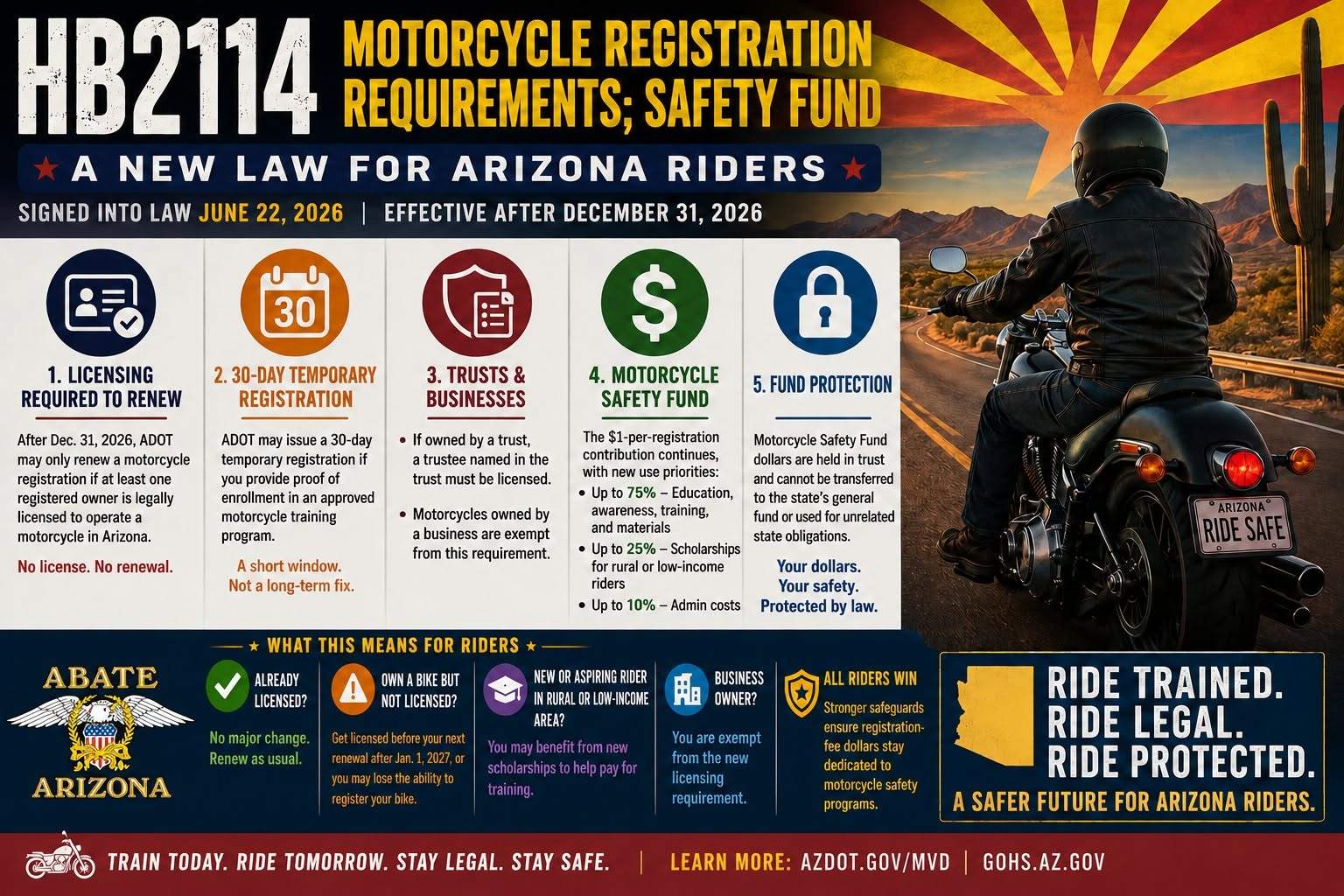
The short version is this: beginning after December 31, 2026, Arizona will tie motorcycle registration renewal to lawful motorcycle licensure. At least one registered owner of a motorcycle must be legally licensed to operate a motorcycle in Arizona before ADOT may renew that motorcycle’s registration. If the owner is not yet licensed but is enrolled in an approved motorcycle training program, ADOT may issue a 30-day temporary registration. The law also protects the Motorcycle Safety Fund, keeps the $1 motorcycle registration contribution dedicated to rider safety, and creates a statutory pathway for scholarships for rural and low-income riders who need help accessing motorcycle training.
That matters.
For years, Arizona riders have paid into a fund meant to support motorcycle education, awareness, training, and safety. HB2114 strengthens the link between the dollars motorcyclists contribute and the rider-focused programs those dollars were meant to support. It also sends a clear message: motorcycle safety policy should be built around training, access, accountability, and keeping rider-generated dollars in rider-focused programs.
What HB2114 Actually Does
HB2114 does five basic things.
First, it creates a new motorcycle registration renewal requirement. After the effective date, ADOT may renew a motorcycle registration only if at least one registered owner is licensed to legally operate a motorcycle in Arizona. This means a person who owns a motorcycle but has no motorcycle license or endorsement will need to correct that before renewing the registration.
Second, it gives new or unlicensed riders a limited bridge. If the person shows valid proof of enrollment in an ADOT-approved motorcycle training program, ADOT may issue a 30-day temporary registration. That is not a permanent substitute for a motorcycle endorsement. It is a short window to get into training and move toward compliance.
Third, it addresses motorcycles held in trust. If the registered owner is a trust, a trustee named in the trust must be legally licensed to operate a motorcycle in order to renew the registration. That protects ordinary estate-planning arrangements without leaving the statute toothless.
Fourth, it exempts motorcycles owned by a business. Business-owned motorcycles are not subject to the new licensing-linked renewal requirement. That distinction matters for dealerships, fleets, training providers, and other commercial ownership arrangements.
Fifth, it protects and directs the Motorcycle Safety Fund. The law keeps the $1-per-registration deposit into the fund and directs how the money may be used. Up to 75 percent may support voluntary motorcycle education, awareness, training, and related materials. Up to 25 percent may support scholarships for motorcycle driver education programs for people from rural or low-income areas. Up to 10 percent may be used for administrative costs.
The fund-protection language may be the most important part of the bill. HB2114 states that fees, assessments, or other levies collected and deposited into the Motorcycle Safety Fund are held in trust and may be used only for the purposes prescribed by statute. The money may not be appropriated or transferred to fund general state operations or meet general fund obligations.
That is a direct win for motorcyclists.
The Licensing Requirement: What Riders Need to Know
The most immediate rider-facing change is the new registration renewal rule. If you already have a motorcycle endorsement or motorcycle license, this law should not change much for you. You keep renewing as usual.
If you own a motorcycle but do not have the legal authority to operate one, the law changes your posture. You will need to obtain the proper motorcycle license or endorsement before renewal after the effective date. For most adult riders who already hold a regular driver license, that means adding a motorcycle endorsement. For a person who does not hold a regular driver license, Arizona provides a stand-alone Class M motorcycle license.
This is where the bill creates a direct policy line: Arizona will no longer treat motorcycle registration renewal as completely separate from legal motorcycle operation. The state is saying that if a motorcycle is being kept in the stream of registered highway use, at least one registered owner must be legally qualified to operate it.
Critics may argue that ownership and operation are not the same thing. That is true. A person can own a vehicle and never personally drive it. A collector may own bikes. A spouse may register a motorcycle. A family member may hold title for estate or financing reasons. HB2114 softens that concern by requiring only one registered owner to be licensed, by creating a rule for trusts, and by exempting business-owned motorcycles.
That is a narrower rule than a blanket prohibition on ownership. The law does not say every owner must be endorsed. It does not say every motorcycle must be operated by its owner. It does not create a helmet mandate. It does not increase the $1 contribution to the Motorcycle Safety Fund. It does not create a new rider tax. It ties renewal to having at least one legally qualified motorcycle operator among the registered owners.
That is the policy tradeoff.
The 30-Day Temporary Registration Window
HB2114 also recognizes a practical issue: new riders often buy or acquire a motorcycle before completing the endorsement process. Some riders need a short registration window while they enroll in training, complete the course, and finish the licensing process.
The law gives ADOT authority to issue a 30-day temporary registration when the person shows valid proof of enrollment in an approved motorcycle training program.
That matters because it prevents the law from becoming a dead end for new riders. Without the temporary option, a person could be caught in a cycle: unable to renew or register because they are not endorsed, yet unable to move forward in a practical way while entering training. The 30-day temporary registration gives the rider a defined path.
It is not a loophole. It is a bridge.
Riders should treat that temporary registration as a compliance window, not as a workaround. Once the temporary period runs, the rider still needs to complete training and obtain the proper license or endorsement. For new riders, the practical advice is clear: do not wait until renewal month to start the process. Find an approved motorcycle training course, enroll, keep proof of enrollment, complete the course, and update your license.
Trusts and Business-Owned Motorcycles
HB2114 includes two ownership-structure provisions that riders should understand.
If a motorcycle is owned by a trust, a trustee named in the trust must be legally licensed to operate a motorcycle before ADOT may renew the registration. This matters for riders who use trusts for estate planning, family ownership, asset planning, or succession purposes. A motorcycle held in trust is not exempt from the licensing-linked renewal requirement. The law looks to the trustee.
Business-owned motorcycles are treated differently. The new licensing-linked renewal requirement does not apply to motorcycles owned by a business.
That exemption makes sense as a matter of administration. A dealership may own many motorcycles. A training provider may own motorcycles used by students. A company may own motorcycles for business purposes. Requiring a natural person registered owner to hold a motorcycle endorsement would not map cleanly onto every business ownership structure.
For individual riders, the message is direct: do not assume a trust avoids the requirement. If the motorcycle is in a trust, make sure at least one named trustee is legally licensed to operate a motorcycle in Arizona.
The Motorcycle Safety Fund: Why the Money Piece Matters
The Motorcycle Safety Fund is where HB2114 becomes more than a registration bill.
Arizona law already directed $1 from each motorcycle registration fee into the Motorcycle Safety Fund. HB2114 keeps that structure, then tightens how the money may be used.
The bill directs fund dollars toward voluntary motorcycle education, awareness, training, and related materials. It also authorizes scholarships for motorcycle driver education programs for people from rural or low-income areas. That is important because training access is not equal across Arizona. A rider in Phoenix or Tucson may have more course options than a rider in a rural county. A rider with stable income may absorb course fees more easily than a young worker, veteran, student, or low-income rider trying to get legal and trained.
HB2114 recognizes that safety policy cannot be built only for people who already have access. If Arizona wants more riders trained, the state has to make training reachable. Scholarships for rural and low-income riders are a practical step.
The bill also limits administrative costs to up to 10 percent. That matters because special funds can lose public trust when too much money disappears into internal overhead. A cap keeps the focus on rider-facing safety work.
The core principle is simple: rider dollars should serve rider safety.
Fund Protection: The Quiet Victory in HB2114
The strongest language in HB2114 is the fund-protection language.
The bill states that fees, assessments, or other levies collected and deposited into the Motorcycle Safety Fund are held in trust. It also states that the money may be used only for statutory purposes and may not be transferred or appropriated to pay for general state operations or general fund obligations.
That is a major advocacy win.
Dedicated funds are often attractive targets during budget stress. When government faces a shortfall, money sitting in a special fund can look like a convenient backstop. Riders know what that means: they pay a fee for motorcycle safety, then watch the money drift away from motorcycle safety.
HB2114 says no.
This is the part of the law riders should pay close attention to. The licensing requirement will get most of the public discussion because it changes what some owners must do before renewal. The safety fund protection may have the longer policy life. It guards the purpose of the money. It gives rider advocates a statutory hook if future budget negotiations attempt to raid the fund. It also creates a cleaner accountability standard for how the money is spent.
If motorcycle money is collected for motorcycle safety, it should stay with motorcycle safety.
Why This Matters for Rider Advocacy
HB2114 shows what effective motorcycle policy can look like when the frame is not anti-rider regulation, but rider-centered safety.
Too often, motorcycle bills fall into one of two categories. The first category is punitive: more restrictions, more penalties, or more assumptions that riders are the problem. The second category is symbolic: awareness language that sounds good but does not change systems, training access, or funding protection.
HB2114 is different. It takes an existing rider-paid fund and strengthens the connection between that money and rider-focused use. It creates a scholarship path for riders who may need help accessing training. It protects the fund from diversion. It also addresses unlicensed ownership in a way that leaves room for new riders, trusts, and business ownership.
That does not mean every rider will love every part of the bill. Some will dislike the registration renewal tie. Some will question why ownership status should depend on licensure. Those are fair policy concerns. But the final version is narrower than a broad ownership restriction. It applies to renewal. It requires only one registered owner to be legally licensed. It permits a 30-day temporary registration for those enrolled in approved training. It exempts business-owned motorcycles. It addresses trusts.
The result is a bill that balances rider accountability with training access and fund protection.
What Riders Should Do Before January 1, 2027
Riders should use 2026 as a compliance year.
If you already have a motorcycle endorsement, check your license and make sure the endorsement is visible and current. If your motorcycle is jointly titled or registered, make sure at least one registered owner has the legal authority to operate a motorcycle in Arizona.
If you own a motorcycle and do not have a motorcycle endorsement, do not wait until renewal time. Start the licensing process. Arizona allows a person who already has a driver license to add a motorcycle endorsement. A person without a regular driver license may obtain a stand-alone Class M motorcycle license. Approved motorcycle training can help riders move through the process and, in some circumstances, may allow a rider to avoid separate written or road testing.
If your motorcycle is held in a trust, review the trust ownership structure. Make sure a named trustee is legally licensed to operate a motorcycle. Do not assume that because the motorcycle is in a trust, ADOT will treat it like a business-owned motorcycle. The statute treats trusts and businesses differently.
If you are a new rider, enroll in training early. Keep proof of enrollment. The 30-day temporary registration option depends on proof of enrollment in an approved motorcycle training program.
If you are in a rural or low-income area, watch for scholarship availability once the funding structure is in place. One of the best parts of HB2114 is that it recognizes training access as a real issue. Riders outside the largest metro areas should not be left behind.
What ABATE, Rider Groups, and Advocates Should Track Next
The signing of HB2114 is not the end of the work. It is the start of the next phase.
Rider advocates should track how ADOT applies the renewal requirement. Clear instructions will matter. Riders need to know what proof ADOT will accept, how joint ownership will be handled, how trust-owned motorcycles will be reviewed, and how temporary registrations will be processed.
Advocates should track how the Governor’s Office of Highway Safety uses the Motorcycle Safety Fund. The statute creates categories, but the real-world value will depend on spending decisions. Are the dollars reaching training programs? Are scholarships being used by rural riders? Are low-income riders learning about the program? Are administrative costs staying within the cap? Are safety materials reaching drivers as well as riders?
Advocates should also push for transparent reporting. The state should be able to show how much money enters the fund, how much is spent, where it goes, how many riders receive scholarships, how many courses are supported, and whether rural counties are being served.
That is the next accountability fight.
A fund-protection statute is only as strong as the oversight behind it. HB2114 gives rider advocates a stronger legal position. Now the motorcycle community needs to make sure the law produces measurable benefit.
The Bottom Line
HB2114 is a meaningful rider safety law because it does three things at once.
It pushes unlicensed motorcycle owners toward legal operation.
It expands the role of motorcycle safety education and training scholarships.
It protects rider-paid safety dollars from being diverted to unrelated state spending.
For riders who are already endorsed, the registration piece should be simple. For owners without an endorsement, the message is clear: get licensed before renewal after January 1, 2027. For new riders, training enrollment can provide a temporary 30-day registration path, but that is only a bridge. For rural and low-income riders, the scholarship language may open doors that were previously closed. For rider advocacy groups, the trust-fund protection is a strong tool for future budget fights.
This is what practical motorcycle policy should look like: protect the money riders pay, expand access to training, respect lawful riders, and build safety policy around education rather than punishment.
HB2114 is not the final word on motorcycle safety in Arizona. It is a solid step in the right direction.
Ride safe. Ride free.