
LANE SPLITTING IS NOW RECKLESS DRIVING
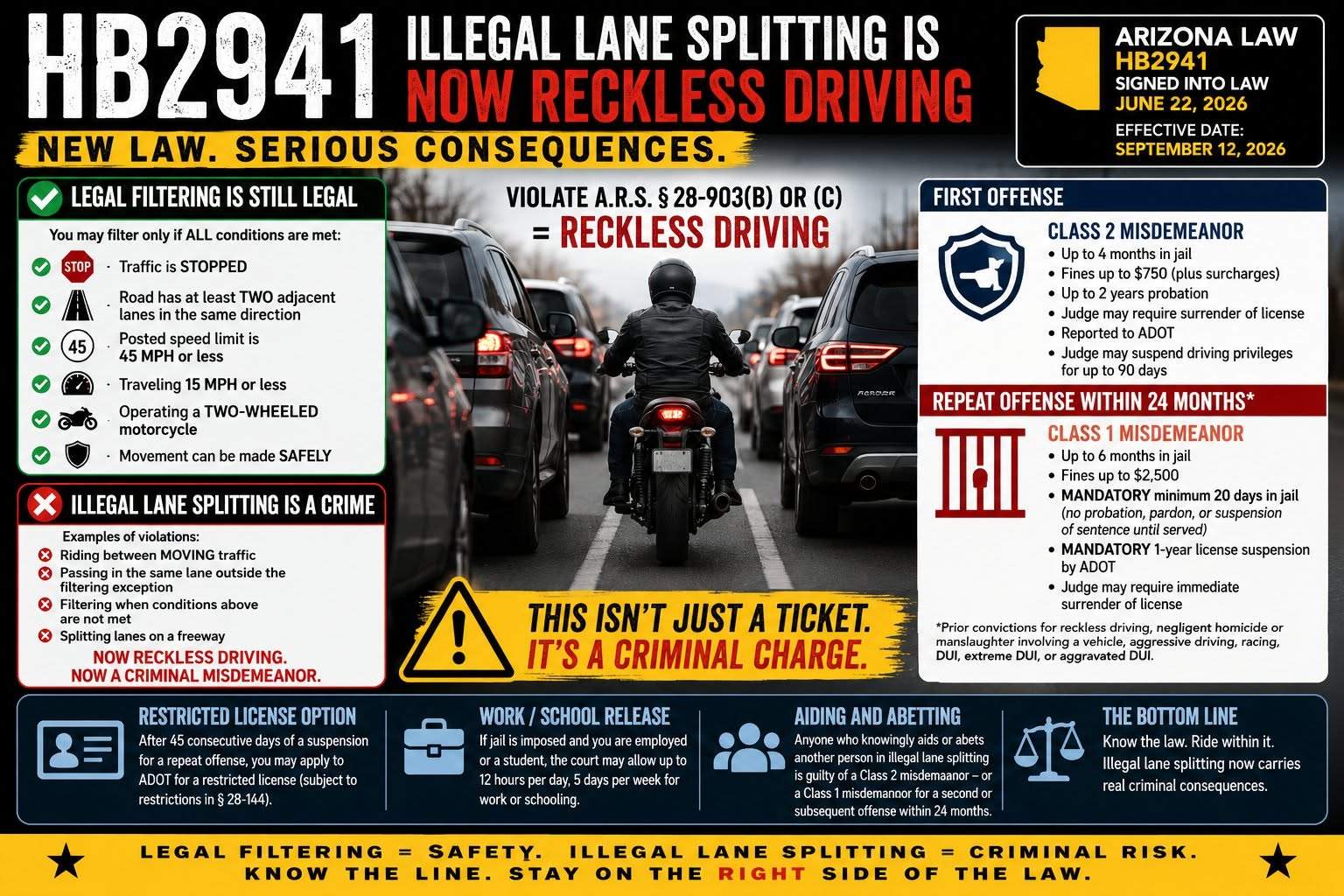
This new law may catch a few motorcyclists out if they don’t understand the details. If you are a rider who practices lane FILTERING, please take some time to understand the latest change to Arizona Revised Statutes 28-903(B) or A.R.S. 28-903(C). Check out our previous article on lane filtering to refresh your memory on the precise details of that bill.
The big takeaway is that what was once a minor traffic infraction will now be treated as criminal misdemeanor.
Here is the full breakdown of HB2941 from the perspective of Michael Infanzon at COPPER DOME UPDATE:
Arizona motorcyclists need to pay attention to HB2941.
This bill is now law. It changes how Arizona treats illegal lane splitting and improper same-lane passing by motorcycle riders. More importantly, it takes conduct that many riders may have thought of as a traffic ticket and moves it into reckless driving territory.
That is not a small change.
Under HB2941, operating a motorcycle in violation of A.R.S. § 28-903(B) or A.R.S. § 28-903(C) is now classified as reckless driving under Arizona law. That means illegal lane splitting is not being treated as a minor traffic infraction. It is being treated as a criminal misdemeanor.
Let’s slow that down for a minute.
Arizona already has a lane filtering law. It is narrow. It is specific. It is not the same as lane splitting. Riders can legally filter only under very limited conditions. Traffic must be stopped. The road must have at least two adjacent lanes in the same direction. The posted speed limit must be 45 miles per hour or less. The motorcycle must be traveling no more than 15 miles per hour. The rider must be operating a two-wheeled motorcycle. The maneuver must be safe.
That is legal lane filtering.
Lane splitting is different. Splitting between moving traffic, passing cars inside the same lane outside the legal filtering rule, or riding between rows of vehicles when the legal conditions are not met is not protected by Arizona law.
HB2941 makes that line matter more than ever.
Before, a rider might have looked at this as a citation risk. Now, the rider is looking at reckless driving. That means possible jail time, criminal fines, probation, license consequences, and, for repeat offenses, mandatory jail and a one-year suspension.
That is the part every Arizona rider needs to understand.
This law does not repeal legal lane filtering. It does not take away the narrow filtering rights Arizona riders fought for. But it does raise the cost of getting it wrong.
Legal Filtering Is Still Legal
The first thing to make clear is this: HB2941 does not ban legal lane filtering.
Arizona riders still have the ability to filter when they stay inside the existing law. That matters because the public often gets this wrong. Drivers get it wrong. Media outlets get it wrong. Sometimes riders get it wrong.
Legal lane filtering is not reckless driving.
Legal lane filtering means the rider is moving between stopped vehicles under Arizona’s narrow statutory conditions. That can be a useful safety tool. Anyone who rides in Arizona traffic understands the risk of being trapped at the back of stopped traffic with a distracted driver coming up from behind. A motorcycle does not have the same rear-end protection as a car or truck. Filtering gives a rider a lawful way to move out of that danger zone when the conditions are right.
But the law has limits.
If traffic is moving, you are not filtering under the Arizona statute. If the road is posted over 45 miles per hour, you are not filtering under the statute. If you are traveling more than 15 miles per hour, you are outside the legal protection. If you are on a freeway, you are outside the legal protection. If you are forcing your way between vehicles when it cannot be done safely, you are outside the legal protection.
That is where HB2941 comes in.
The bill says that when a motorcycle operator violates A.R.S. § 28-903(B) or (C), that violation is reckless driving. In plain English, if you split lanes illegally or pass inside the same lane illegally, Arizona law now treats that as reckless driving.
That is the new risk.
First Offense: This Can Now Be a Criminal Case
A first reckless driving offense in Arizona is a class 2 misdemeanor.
That means a rider convicted under this new framework could face up to four months in jail, a fine of up to $750 before surcharges, and probation. The judge can also require surrender of the driver license to a police officer. The conviction is reported to ADOT. The judge may suspend driving privileges for up to 90 days.
That is not just “pay the ticket and move on.”
This is a criminal misdemeanor. It can show up in background checks. It can affect employment. It can affect insurance. It can affect professional licensing. It can affect people who drive for work. It can affect people who already have other traffic issues on their record.
For riders, this means the old casual attitude around lane splitting needs to end. Arizona is not California. Arizona does not have general lane splitting. Arizona has limited lane filtering. Those are different legal concepts, and HB2941 puts criminal consequences behind that distinction.
A rider who understands the law can still filter legally.
A rider who assumes all lane splitting is fine because “Arizona allows it now” can end up with a reckless driving charge. A rider who just doesn’t care and splits anyway should expect to be arrested.
That misunderstanding is going to hurt people if we do not educate the riding community.
Repeat Offense: Mandatory Jail and a One-Year Suspension
The repeat-offense provision is where this gets serious.
If a rider has a qualifying prior conviction within 24 months, a new reckless driving conviction becomes a class 1 misdemeanor. That is the most serious misdemeanor class in Arizona. It can carry up to six months in jail and up to $2,500 in fines.
But the bigger issue is the mandatory penalty.
For a qualifying repeat offense, the person must serve at least 20 days in jail. The court cannot simply waive it. The person is not eligible for probation, pardon, suspension of sentence, or release on any basis until those 20 days are served.
ADOT must also suspend the person’s driving privilege for one year.
That is a major consequence.
The prior offense does not have to be reckless driving alone. The statute looks at a list of qualifying prior offenses, including reckless driving, certain homicide or assault offenses involving a vehicle, aggressive driving, racing, DUI, extreme DUI, and aggravated DUI.
So, a rider with one of those prior convictions in the last 24 months has much more exposure if convicted again under this reckless driving framework.
Think about what that means in the real world.
A one-year suspension can affect whether someone gets to work. It can affect whether they can take kids to school. It can affect whether they can care for a spouse or parent. It can affect whether a veteran gets to appointments. It can affect whether a small business owner can keep operating.
The law does allow a restricted license option after at least 45 consecutive days of suspension have been served, but that is not automatic relief. It is a restricted license through ADOT, and it comes with limits.
The practical message is simple: do not put yourself in that position.
Work and School Release Does Not Make This Minor
Arizona law does allow a court to authorize work or school release in some situations. If a person is sentenced to jail and is employed or a student, the court may allow that person to continue working or attending school for up to 12 hours per day, five days per week.
That may sound like a cushion.
It is not.
You are still serving a jail sentence. You are still going back to jail when work or school is over. You are still dealing with a criminal conviction. You are still dealing with the cost, stress, and disruption that comes with it.
That is why riders need to stop thinking about illegal lane splitting as just a traffic issue. HB2941 puts it in a different category.
Group Rides and Aiding and Abetting
There is another piece of this law that motorcycle clubs, riding groups, event organizers, and road captains should understand.
Arizona reckless driving law includes aiding and abetting. A person who knowingly aids or abets someone else in reckless driving can also be charged. For a first offense, that is a class 2 misdemeanor. For a second or later offense within 24 months, it can become a class 1 misdemeanor.
That does not mean every person in a group ride is responsible for what every other rider does.
But it does mean groups should be careful.
If a ride plan encourages illegal lane splitting, if riders are told to move between traffic outside the legal filtering rules, if people block traffic to let others split lanes illegally, or if the ride culture pushes riders into conduct that violates A.R.S. § 28-903(B) or (C), there may be exposure beyond the individual rider.
This is where leadership matters.
Road captains should brief riders before the ride. Clubs should make the rule clear. Legal filtering is legal. Illegal lane splitting is not part of the ride plan. Riders are expected to stay inside Arizona law.
That protects the riders. It protects the organization. It protects the event. It protects the motorcycle community’s credibility.
Why This Law Matters Politically
There is a reason this bill deserves discussion beyond the penalty chart.
Motorcycle policy always sits at the intersection of freedom, safety, public perception, and enforcement. When riders ask for legal protection, lawmakers look at how the community handles responsibility. When riders defend lawful filtering, the argument is stronger if the community also rejects reckless conduct.
That does not mean we accept every heavy-handed penalty without question.
HB2941 is a strong enforcement tool. It takes a motorcycle-specific lane-use violation and places it inside reckless driving. That is a major policy choice.
Reckless driving usually carries the idea of serious disregard for the safety of people or property. HB2941 makes a violation of these motorcycle lane-use provisions reckless driving as a matter of law. That may make sense in cases where a rider is splitting lanes through moving traffic at unsafe speeds. It may make sense when a rider is creating real danger.
But there will be edge cases.
What happens when a rider is accused of filtering slightly above 15 miles per hour? What happens when traffic is barely moving and the rider believes the cars are stopped? What happens when an officer does not understand the difference between legal filtering and illegal splitting? What happens when a driver complains because the driver does not like motorcycles filtering, even when the rider was inside the law?
Those are real questions.
The law is now on the books. The next fight is making sure it is applied correctly.
Enforcement Needs to Be Precise
Law enforcement needs to get this right.
There is a clear legal difference between a rider lawfully filtering through stopped traffic on a surface street and a rider splitting between moving cars on the freeway. Those are not the same thing. Treating them the same would be bad enforcement and bad policy.
The facts matter.
Was traffic actually stopped? What was the posted speed limit? Was the motorcycle traveling no more than 15 miles per hour? Were there at least two adjacent lanes moving in the same direction? Was the rider on a two-wheeled motorcycle? Was the maneuver safe?
Those are the questions that should be asked before this becomes a reckless driving case.
Officers should be trained on the difference between filtering and splitting. Prosecutors should review the facts before moving forward. Courts should require proof that the rider was actually outside the lawful filtering exception.
Motorcyclists should not be criminalized for conduct Arizona law still allows.
At the same time, riders should not expect sympathy if they are blasting between moving cars and calling it filtering. That is not filtering. That is illegal lane splitting, and under HB2941, it is reckless driving.
Both things can be true.
What Riders Should Do Now
The first step is simple: learn the rule.
If you ride in Arizona, you should know the filtering law cold. You should not have to guess. You should not rely on what someone told you at a gas station, on Facebook, or in a riding group.
Legal filtering requires stopped traffic, a road posted at 45 miles per hour or less, at least two adjacent lanes in the same direction, a two-wheeled motorcycle, a speed of 15 miles per hour or less, and safe movement.
If one of those pieces is missing, do not assume you are protected.
Second, educate the people you ride with. This should be part of every group ride briefing. It should be in club safety materials. It should be posted by motorcycle rights organizations. It should be discussed by instructors, dealers, and rider coaches.
Third, document your rides where appropriate. A helmet camera or motorcycle camera can matter if you are accused of illegal conduct when you were actually filtering legally. Video can answer questions about traffic movement, speed, lane structure, and driver behavior.
Fourth, do not let drivers define the law. Some drivers hate filtering because they think riders are cutting the line. That is not the law. Arizona allows legal filtering because motorcycles face different risks in stopped traffic. A driver’s frustration does not turn legal filtering into reckless driving.
Fifth, track enforcement problems. If riders begin seeing improper citations, inconsistent charging, or law enforcement confusion, that needs to be documented. Rider organizations should collect incident reports, court outcomes, body-camera footage where available, and examples of misapplication.
Data beats complaints. Documentation beats rumors.
What Drivers Need to Understand
Drivers also need to learn the law.
If a motorcycle is legally filtering, do not block it. Do not open a door. Do not swerve. Do not crowd the lane. Do not try to teach the rider a lesson. That kind of behavior can injure or kill someone.
Legal filtering is not an invitation for road rage.
Drivers may not like it. That does not matter. Arizona law allows it under narrow conditions.
The flip side is also true. Riders do not get to use the filtering law as a free pass to split lanes wherever they want. The law is narrow. Drivers should expect riders to follow it. Riders should expect drivers to understand it.
That is how this works.
The Bigger Motorcycle Rights Lesson
HB2941 is a reminder that motorcycle rights work is not just about stopping bad bills. It is also about making sure good laws are understood and existing laws are applied correctly.
Arizona’s lane filtering law was a win for riders. But every win comes with the need for education. If the public does not understand the law, riders get blamed. If law enforcement does not understand the law, riders get cited. If riders do not understand the law, they create bad cases and bad headlines.
That is why ABATE and the broader motorcycle rights community have work to do here.
We need to continue to defend legal filtering. Which we do.
We need to educate riders on the limits.
We need to push back against drivers who think they can use their vehicles to police motorcycles.
We need to make sure police agencies understand the statute.
We need to track whether HB2941 is being used against actual dangerous conduct or whether it becomes a trap for riders who are trying to follow the law.
That is the advocacy lane.
Bottom Line
HB2941 changes the stakes.
Illegal lane splitting in Arizona is now reckless driving. That means criminal misdemeanor exposure, possible jail, fines, probation, license suspension, and serious repeat-offense penalties. For a qualifying repeat offense within 24 months, the law can mean mandatory jail and a one-year license suspension.
Legal lane filtering remains legal.
That distinction is everything.
If traffic is stopped, the road is posted at 45 miles per hour or less, there are at least two adjacent lanes in the same direction, you are on a two-wheeled motorcycle, you are traveling no more than 15 miles per hour, and the movement is safe, you are inside Arizona’s filtering law.
If not, you may be looking at reckless driving.
Riders need to know the line. Groups need to teach the line. Law enforcement needs to enforce the line correctly. Drivers need to respect the line.
The motorcycle community fought for legal filtering because it made sense for rider safety. We should defend it. But we also need to be honest with riders: HB2941 means the penalty for getting this wrong is no longer minor.
Know the law before you ride.